UV-A, UV-B, UV-C – Only One of These Actually Disinfects Your Water. Do You Know Which?
Posted on April 19, 2026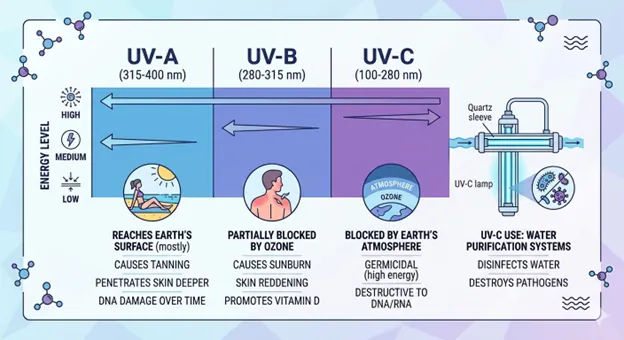
Pick up almost any UV water purifier and somewhere on the box you’ll see the phrase “UV technology.”
What the label rarely tells you is that ultraviolet light spans a wide range of energies — and only a very specific portion of it has the power to render waterborne pathogens harmless.
Sunlight contains UV radiation. Tanning beds use UV radiation. Hospital operating theatres use UV radiation. Yet the sunlight streaming through your window won’t disinfect your drinking water. Why? Because the type of UV matters enormously — and most consumers have never been told the difference.
The UV Spectrum: A Quick Map
Ultraviolet radiation occupies the electromagnetic spectrum between visible light and X-rays, with wavelengths between roughly 100 nm and 400 nm. Scientists divide this band into three regions:
- UV-A – 315–400 nm
- UV-B – 280–315 nm
- UV-C – 100–280 nm
But for water disinfection, only the UV-C range (200–280 nm) is effective — with 254 nm being the most widely used germicidal wavelength.
Relative proportions are illustrative. Shorter wavelengths carry higher energy.
Each band behaves differently — in the atmosphere, on your skin, and critically, when it encounters a microorganism in water.
UV-A
315 – 400 nm · Longest wavelength
Ineffective for disinfection
While this makes up the majority of UV radiation reaching the Earth’s surface, it is mainly responsible for suntanning, fading fabrics, and is used in tanning beds. Its long wavelength carries relatively low energy — insufficient to achieve reliable microbial inactivation in water treatment applications
UV-B
280 – 315 nm · Medium wavelength
Limited germicidal effect — not used in water treatment
This wavelength carries more energy than UV-A and causes sunburn. It has some germicidal activity in principle, but its efficiency against waterborne pathogens is far below what practical water treatment systems require.
UV-C
100 – 280 nm · Shortest wavelength
The only true germicidal UV
Short-wave UV-C carries the highest energy in the UV band. At wavelengths between 200–280 nm — and especially near 254 nm — it is absorbed directly by microbial DNA or (RNA in viruses), making it the sole UV type used in water disinfection systems worldwide. The germicidal peak occurs around 254 nm, which corresponds to the maximum DNA absorption wavelength
Why UV-C? The Science of How It Kills Pathogens
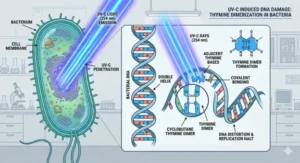
The answer lies in molecular biology, not just physics. Microorganisms — bacteria, viruses, protozoa — all carry genetic material encoded in nucleic acids – DNA (or RNA in viruses). To survive, they must be able to replicate that genetic code. UV-C disrupts this process at its most fundamental level. Effective disinfection depends not only on wavelength but also on delivering sufficient UV dose.
How UV-C neutralises a pathogen :-
- Absorption at the right wavelength. The nucleic acid bases in microbial DNA — particularly thymine — absorb UV energy most strongly between 240–280 nm. At 254 nm (the peak output of standard low-pressure germicidal lamps), absorption is near-maximum.
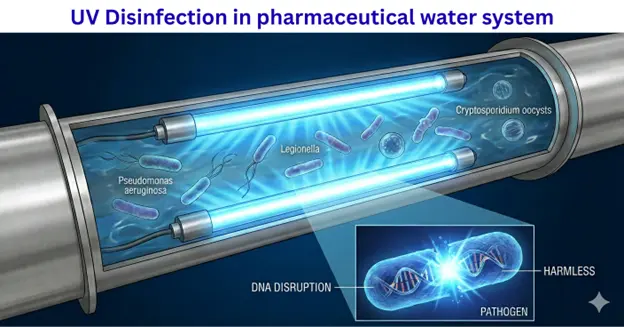
- Formation of thymine dimers. When two adjacent thymine bases absorb UV-C photons, they bond together abnormally — a defect called a cyclobutane pyrimidine dimer (CPD). This disrupts the DNA strand.
- Replication blocked. The cell’s copying machinery cannot read past the dimer. The organism cannot reproduce. Even if it remains technically “alive,” it is rendered clinically harmless — unable to cause infection.
- No chemical residue. Unlike chlorination, this is a purely physical process. UV-C leaves no taste, no odour, no trihalomethanes, does not alter water chemistry.
UV-A and UV-B have significantly lower germicidal effectiveness and are not practical for water disinfection.
“The germicidal effectiveness of different UV wavelengths follows a clear hierarchy: UV-C is far superior to UV-B, which is in turn far superior to UV-A — with UV-C being the only band of practical value for water treatment.” – Wikipedia
The Sweet Spot: 254 nm
Within the UV-C range itself, not all wavelengths are equal. The absorption spectrum of DNA peaks at approximately 260–265 nm.
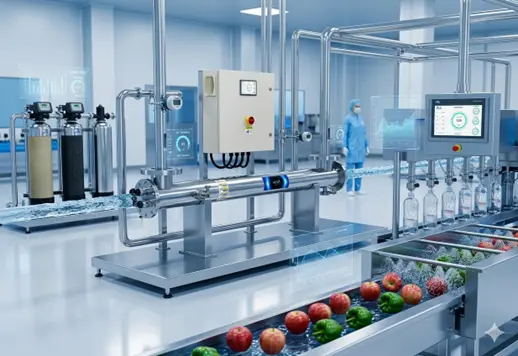
UV systems designed by Alfaa UV use low-pressure high-output amalgam UV lamps that emit predominantly at 254 nm — well within the highly effective germicidal range.
Amalgam lamps deliver higher UV output in a compact form, perform reliably across varying water temperatures, and maintain more stable germicidal output over their service life.
This is the proven, field-validated technology behind Alfaa UV’s water purification systems — trusted across residential, commercial, pharmaceutical, and industrial applications. System performance depends on both lamp output and proper reactor design to deliver adequate UV dose.
Effective Disinfection by UV-C. Scoring over Chlorine
One of UV-C’s most important properties is its broad-spectrum effectiveness. Unlike chemical disinfectants, which can leave certain organisms relatively unaffected, a properly dosed UV-C system inactivates a wide range of waterborne pathogens, both bacteria and viruses.
Notably, Pseudomonas Aeruginosa, Cryptosporidium and Giardia Lamblia are waterborne bacteria and protozoan parasites worth paying close attention to. These are resistant to chlorine — the disinfectant used in most municipal water supplies — and for sanitization of piping systems across industries and institutions. This is one of the main reasons why UV-C disinfection has become widely adopted in water treatment plants around the world especially for critical applications in hospitals, and in food and pharma industries.
The US EPA has officially recognized UV-C as an effective method for drinking water treatment, particularly because of its ability to successfully inactivate these chlorine-resistant pathogens where chlorine falls short.
For more info read :- Different Water Disinfection Methods
When UV-C Needs Help: The Role of Pre-Filtration
UV-C is extraordinarily effective — but it is not magic. Its primary dependency is water clarity and UV transmittance (UVT). Suspended particles, turbidity, and dissolved organic compounds that absorb UV can shield microorganisms from UV-C radiation, reducing effective dose delivery. This is why properly engineered UV systems are always paired with appropriate pre-filtration — to ensure that the water entering the UV chamber is clear enough for the light to do its job.
Alfaa UV systems are engineered with this principle at the core. Based on source water quality, appropriate pre-treatment is specified to ensure that the required UV-C dose is consistently delivered — meeting validated disinfection targets across applications.
Why Alfaa UV-C disinfection systems are preferred in India’s water disinfection story.
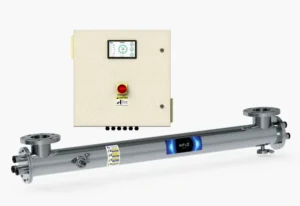
With over two and a half decades of field experience, more than a thousand installations, and exports to 15+ countries, Alfaa UV has built UV-C systems from 100 LPH to 2,00,000 LPH — all engineered around the same principle: delivering the right dose of the right wavelength, every single time.